
Heat exchanger calculation
Calculating a heat exchanger comes down to four quantities: the capacity to be transferred, the temperatures on both sides, the flow rate and the required plate surface area. This page contains the formulas with a worked example, a calculation aid that lets you work out those quantities right here, and the online sizing tool. If you get stuck, our specialists will make the calculation for you and include a quotation the same working day.
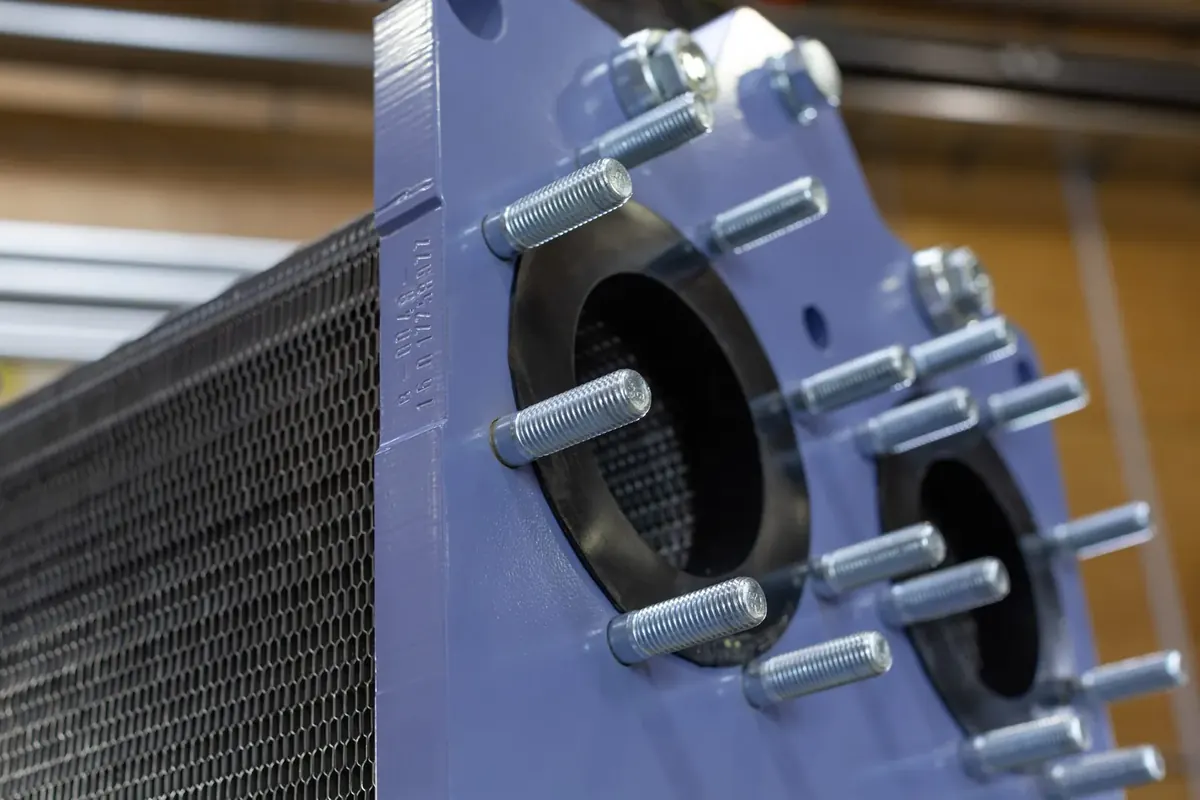
Calculate your heat exchanger yourself
Calculate it yourself
With the UNEX online calculation tool you can quickly work out the right heat exchanger yourself, including current stock and list prices.
Calculate your heat exchanger hereLet us calculate your heat exchanger
Prefer to leave it to us? Send us your details and our specialists will draw up the calculation and a tailored quote.
Request your calculation and quoteCalculate it yourself with the online sizing tool
For UNEX heat exchangers there is an online sizing tool in which you enter the process conditions and immediately get a suitable model back, including availability and the gross price. That gross price is a list price; many customers qualify for a lower net price based on fixed agreements. You can save projects in the tool, so your calculations are kept for later.
Or let us make your calculation
Do you have the figures, but not the time or the calculation expertise? Then fill in the calculation form with the temperatures, flow rate and medium of both sides. Our specialists will make the calculation and send a matching quotation within one working day. If you are unsure about a value, simply leave the field empty — the form calculates the missing temperature or flow rate for you, as long as the medium is water.
The formulas behind a heat exchanger calculation
If you want to check the numbers yourself, four formulas are all you need. They belong together: the capacity follows from the flow rate and the temperature difference, and that capacity, together with the temperature difference across the exchanger, determines how much plate surface area you need. Below they are listed in the order you use them in practice. For readability, water is used as the medium.
Calculating heat exchanger capacity
The capacity of a heat exchanger is the heat flow it transfers, expressed in kW. The formula is Q = m × cp × ΔT: the mass flow rate times the specific heat times the temperature difference. For water you can work with the volume flow rate, which is quicker:
Q (kW) = flow rate (m³/h) × 1.163 × ΔT (K)
The factor 1.163 comes from the specific heat of water (4.186 kJ/kg·K) times the density (1,000 kg/m³), divided by 3,600 seconds per hour. If you work with a glycol mixture, the specific heat and density are different and that factor changes; in that case pass on the mixing percentage and we will calculate with the correct values.
Calculating heat exchanger duty
The duty of a heat exchanger is the same quantity as the capacity, only approached from your installation: how many kW need to be removed or added? If you already know the duty, you turn the formula around and work back to the required flow rate or temperature difference.
Flow rate (m³/h) = Q (kW) ÷ (1.163 × ΔT) and ΔT (K) = Q (kW) ÷ (1.163 × flow rate)
An example. For 120 kW at a difference of 10 K you need 120 ÷ (1.163 × 10) ≈ 10.3 m³/h. The same method applies when calculating the duty of a plate heat exchanger — the type of exchanger does not change the energy balance, only the required surface area.
Calculating heat exchanger efficiency
The efficiency of a heat exchanger, also called the effectiveness, is the ratio between the temperature change you actually achieve and the maximum possible change. That maximum change is the difference between the two inlet temperatures.
ε = (T hot in − T hot out) ÷ (T hot in − T cold in)
An exchanger that brings water from 80 °C down to 50 °C while the cold side enters at 20 °C achieves (80 − 50) ÷ (80 − 20) = 0.50. The closer you want to get to 1, the more plate surface area it costs — efficiency is therefore mainly a design choice, not a property of the device.
Calculating heat exchanger surface area
The required plate surface area follows from the duty, the heat transfer coefficient and the mean temperature difference across the exchanger:
A (m²) = Q ÷ (U × ΔT log)
Here A is the surface area, U the heat transfer coefficient in kW/m²·K and ΔT log the logarithmic mean temperature difference (see below). The U-value is the tricky one: it depends on the medium, the flow velocity, the plate geometry and the degree of fouling, and cannot simply be taken from a table. The selection software contains that value per plate type; that is why the final step of a heat transfer calculation runs through the sizing tool or through us in practice.
Counter-flow heat exchanger calculation
In a plate heat exchanger the two media run in counter-flow: they move towards each other instead of alongside each other. That keeps the temperature difference roughly constant along the entire length and yields a higher mean difference than parallel flow, so you need less surface area. You calculate the mean difference like this:
ΔT log = (ΔT1 − ΔT2) ÷ ln(ΔT1 ÷ ΔT2)
ΔT1 and ΔT2 are the temperature differences at the two ends of the exchanger. In counter-flow, ΔT1 is the difference between the hot inlet and the cold outlet, and ΔT2 the difference between the cold inlet and the hot outlet. If both differences are equal, ΔT log equals that difference and you do not need the logarithm.
Calculate a heat exchanger without an Excel file
Those who calculate regularly usually reach for a spreadsheet. That is not necessary here: you do not need an Excel file to calculate a heat exchanger, because the calculation aid on this page does the same work. You enter the temperatures, the flow rate and the required capacity and immediately see the temperature difference, the logarithmic mean and the required surface area.
So if you are looking for a heat exchanger calculation in Excel, you can skip that step and calculate right here. The result gives a good first indication for sizing. For the final selection of a type we are happy to look at it with you, because the heat transfer coefficient differs per plate type.
Heat exchanger calculation: calculate here directly
Enter the temperatures and the flow rate of both sides. You immediately see the duty per side, the log mean temperature difference in counterflow and — as soon as you enter a heat transfer coefficient yourself — the required plate area. No Excel file needed.
Not sure of the duty? Leave this field empty — it then follows from the temperatures and the flow rate. If you do enter it, we work out a missing temperature or a missing flow rate for you.
Hot side
The medium that gives off heat
Cold side
The medium that absorbs heat
Calculating heat exchanger duty
Q (kW) = flow rate (m³/h) × 1.163 × ΔT (K)
Enter the two temperatures and the flow rate of at least one side.
Counterflow heat exchanger calculation: LMTD
ΔT1 = hot in − cold out · ΔT2 = hot out − cold in · LMTD = (ΔT1 − ΔT2) ÷ ln(ΔT1 ÷ ΔT2)
Enter all four temperatures and we will calculate the log mean temperature difference in counterflow.
Calculating heat exchanger effectiveness
ε = (T hot in − T hot out) ÷ (T hot in − T cold in)
Enter the temperatures of the hot side and the inlet temperature of the cold side.
Calculating heat exchanger area
A (m²) = Q (W) ÷ (U (W/m²K) × LMTD (K))
We deliberately do not fill in a value here: the U-value depends on the plate type, the medium and the fouling factor. If you know the value from your own design, enter it. If not, we determine it in our calculation.
As soon as the duty, the LMTD and a U-value of your own are known, we calculate the required area.
Please note: these results are an indication based on water as the medium. If you work with glycol, oil or steam, different values apply. Our specialists make the final calculation and select the type — you receive a quote with it the same working day.
Calculating a plate heat exchanger: where the type makes the difference
The energy balance above applies to every heat exchanger. The difference lies in the final step: how many plates do you need, and which model. Calculating a plate heat exchanger in practice means translating the required surface area into a number of plates of a particular type — while staying within the permitted pressure drop. More plates means more surface area, but also a different flow velocity and therefore a different pressure drop.
With a gasketed model you can add plates later if the capacity falls short; with a brazed model the number of plates is fixed. That makes the upfront calculation more important for a brazed exchanger.
From calculation to quotation
Once your calculation is complete, the rest is short: pass on the calculated capacity and the connection size, and we will send a quotation within one working day with the model and its availability. If you have doubts about the outcome or the model, our specialists will take a look with you — call +31 (0)162 429 068 or request heat exchanger advice.
How can we help you?



Need personal advice?
You can call us directly on +31 (0)162 429 068 between 08:30 and 17:00, Monday to Friday. Outside these hours you can reach us in the following ways.
- Fill in the contact form.
- Send us an email at sales@hexchange.eu


Heat exchanger replacement